
226 lines
12 KiB
Markdown
226 lines
12 KiB
Markdown
---
|
||
title: "QwenPaw Driver: A Unified Capability Access Layer"
|
||
date: 2026-07-01
|
||
author: QwenPaw Team
|
||
tags: [CapabilityIntegration, ProtocolAdapters, AccessControl, MCP]
|
||
excerpt: "Agent systems are evolving rapidly. Today's Agent no longer calls just a few built-in tools — it needs to interface with MCP Servers, remote Agents (A2A), ACP services, and potentially more protocols in the future."
|
||
---
|
||
|
||
# QwenPaw Driver: A Unified Capability Access Layer
|
||
|
||
## Why We Built the Driver Layer
|
||
|
||
Agent systems are evolving rapidly. Today's Agent no longer calls just a few built-in tools — it needs to interface with MCP Servers, remote Agents (A2A), ACP services, and potentially more protocols in the future.
|
||
|
||
These capabilities differ in **communication modes** (stdio / HTTP / WebSocket), **authentication mechanisms** (static tokens / OAuth2 / AK/SK), and **protocol formats** (JSON-RPC / REST / gRPC). If the Agent is tightly coupled to these differences, every new external capability requires modifying core Agent code. This violates the Open-Closed Principle and fragments security governance.
|
||
|
||
We need to answer a fundamental question: **How should an Agent system perceive and manage heterogeneous external capabilities?**
|
||
|
||
## What is a Driver
|
||
|
||
> **Driver abstracts external capability access into a unified, protocol-agnostic resource model, enabling the Agent system to uniformly declare, invoke, and govern them.**
|
||
|
||
Three keywords define Driver's value:
|
||
|
||
- **Declarative** — The system knows which external capabilities exist and how to reach them
|
||
- **Invocable** — Calls are made through a standard interface, hiding underlying protocol differences
|
||
- **Governable** — Controls who can invoke what, under which conditions, down to individual tools
|
||
|
||
Driver does not own external services. External services exist independently, are deployed independently, and have their own lifecycle. Driver abstracts **connection and invocation**, not the services themselves.
|
||
|
||
MCP is our first concrete protocol implementation. A2A, ACP, and future protocols can be extended via `register_handler_type()`.
|
||
|
||
## Architecture Overview
|
||
|
||
The Driver Layer consists of five core components:
|
||
|
||
| Component | Responsibility |
|
||
| -------------------- | ------------------------------------------------------------------------------------ |
|
||
| **DriverCard** | Driver's profile: identity, protocol, endpoint, credential references, access policy |
|
||
| **DriverHandler** | Driver's executor: policy adjudication → protocol execution |
|
||
| **DriverCapability** | Unified abstraction of protocol operations as Agent-consumable descriptions |
|
||
| **Access Policy** | Multi-dimensional adjudication: Subject × Principal × Target × Condition → Effect |
|
||
| **DriverManager** | Central manager: type registration + instance building + capability routing |
|
||
|
||
```
|
||
┌────────────────────────────────────────────────────────────────┐
|
||
│ Driver Layer │
|
||
│ │
|
||
│ DriverManager ──builds──▶ DriverHandler │
|
||
│ │ │ │
|
||
│ │ reads/persists │ holds ref │
|
||
│ ▼ ▼ │
|
||
│ ┌─────────────────────────────────────────────────────────────┐
|
||
│ │ DriverCard (YAML) │
|
||
│ │ name · protocol · endpoint · credentials · policy │
|
||
│ └─────────────────────────────────────────────────────────────┘
|
||
│ │
|
||
│ Capability: capability_id + kind + action + schema │
|
||
│ Access Policy: ABAC (Subject × Principal × Target → Effect) │
|
||
└────────────────────────────────────────────────────────────────┘
|
||
▲ invoke_capability()
|
||
│
|
||
┌─────────────────────────┴──────────────────────────────────────┐
|
||
│ Agent Runtime │
|
||
│ build_agent() → Toolkit: [DriverCapabilityTool(cap, invoker)] │
|
||
│ LLM → tool_call → invoker → Handler → protocol exec → result │
|
||
└─────────────────────────────────────────────────────────────────┘
|
||
```
|
||
|
||
## Key Design Decisions
|
||
|
||
### 1. Card-Handler Separation
|
||
|
||
DriverCard is a pure static declaration (YAML file); the Handler is its runtime instance. This separation brings three benefits:
|
||
|
||
- Cards are version-controllable and human-auditable
|
||
- Handlers can be rebuilt independently without losing configuration
|
||
- The same Card format can support different Handler implementations
|
||
|
||
### 2. Mandatory Governance Pipeline
|
||
|
||
Every invocation must pass through the `_authorize_invocation()` governance pipeline — policy adjudication first, protocol execution second. This is not an optional middleware but an **enforced constraint embedded in the Handler invocation path**.
|
||
|
||
```
|
||
invoke_capability()
|
||
└─ _authorize_invocation() ← mandatory
|
||
├─ evaluate_policy(ctx) → allow / deny / ask
|
||
└─ _request_approval(ctx) → delegates to ApprovalGate (on ask)
|
||
└─ protocol_execute(...) ← executes only after policy passes
|
||
```
|
||
|
||
### 3. Capability URI as Stable Identifier
|
||
|
||
Every capability is uniquely identified by a URI, persistently referenceable across sessions:
|
||
|
||
```
|
||
driver://{protocol}/{driver_name}/{kind_plural}/{name}#{action}
|
||
```
|
||
|
||
Examples:
|
||
|
||
- `driver://mcp/github-mcp/tools/create_issue#invoke`
|
||
- `driver://a2a/translate-agent/agents/translate#invoke`
|
||
|
||
The Agent doesn't need to know whether a capability comes from MCP or A2A — it only sees a unified `DriverCapability` description and a single `invoke_capability()` entry point.
|
||
|
||
### 4. Four-Layer Credential Decoupling
|
||
|
||
Credential management uses a four-layer architecture that completely separates declaration from secrets:
|
||
|
||
```
|
||
Layer 1: CredentialRef (reference declaration in Card)
|
||
Layer 2: AsyncCredentialStore (encrypted storage)
|
||
Layer 3: CredentialProvider (resolution + refresh)
|
||
Layer 4: ResolvedCredential (runtime credential injected into Handler)
|
||
```
|
||
|
||
Cards never contain plaintext secrets — only references. The Provider layer supports dynamic registration; non-standard OAuth flows (DingTalk, Feishu, etc.) are adapted by injecting custom `TokenExchanger` implementations.
|
||
|
||
### 5. True Open-Closed Extension
|
||
|
||
Adding a new protocol requires only three steps:
|
||
|
||
1. Implement `XxxDriverHandler` — override `_setup`/`_teardown` + `list_capabilities`/`invoke_capability`
|
||
2. Register: `manager.register_handler_type("xxx", XxxDriverHandler)`
|
||
3. Declare: create a YAML file (`protocol: xxx`)
|
||
|
||
No existing code needs modification. `protocol` is a string (not an enum), ensuring true Open-Closed compliance.
|
||
|
||
## Access Policy: Per-Tool Access Control
|
||
|
||
Access Policy employs an ABAC (Attribute-Based Access Control) model with four-dimensional adjudication:
|
||
|
||
| Dimension | Mapping | Description |
|
||
| --------- | --------------- | --------------------------------------------- |
|
||
| Subject | Caller identity | `user:xxx`, `session:xxx`, `channel:xxx`, `*` |
|
||
| Resource | Target | `{ kind: "tool", name: "search_issues" }` |
|
||
| Principal | Request source | Which channel/app the request originates from |
|
||
| Condition | Environment | Time window constraints |
|
||
|
||
Three adjudication effects:
|
||
|
||
- **allow** — Execute immediately
|
||
- **deny** — Block and return error
|
||
- **ask** — Suspend awaiting human approval (implemented via injected `ApprovalGate` protocol)
|
||
|
||
**Priority resolution**: When multiple rules match, they are sorted by Target specificity > Principal specificity > Subject specificity > Strictness, with the most specific rule winning.
|
||
|
||
This means you can:
|
||
|
||
- Default `ask` all invocations, but `allow` admin users from Console
|
||
- `deny` everyone for specific dangerous tools, even when the default policy is `allow`
|
||
- `allow` during business hours on weekdays, `ask` otherwise
|
||
|
||
## Quick Start: MCP Driver
|
||
|
||
Here's a complete MCP Driver configuration demonstrating credential binding and per-tool access policy:
|
||
|
||
```yaml
|
||
# drivers/mcp/hello-mcp.yaml
|
||
name: hello-mcp
|
||
protocol: mcp
|
||
endpoint:
|
||
transport: stdio
|
||
command: python
|
||
args: ["./mcp_servers/hello_server.py"]
|
||
env:
|
||
ECHO_SECRET:
|
||
source: credential
|
||
credential: static
|
||
field: ECHO_SECRET
|
||
config:
|
||
display_name: Hello MCP
|
||
description: Local stdio MCP demo with print_content and get_secret_status tools
|
||
enabled: true
|
||
policy:
|
||
default_effect: ask
|
||
rules:
|
||
- subject: "*"
|
||
effect: deny
|
||
target: { kind: tool, name: get_secret_status }
|
||
```
|
||
|
||
This configuration does three things:
|
||
|
||
1. **Declares connection** — Launches a local Python MCP Server via stdio
|
||
2. **Binds credentials** — The `ECHO_SECRET` env var is resolved from the credential store; no plaintext in the Card
|
||
3. **Defines access policy** — All invocations require approval by default (`ask`), but `get_secret_status` is completely forbidden (`deny`)
|
||
|
||
### Console Management
|
||
|
||
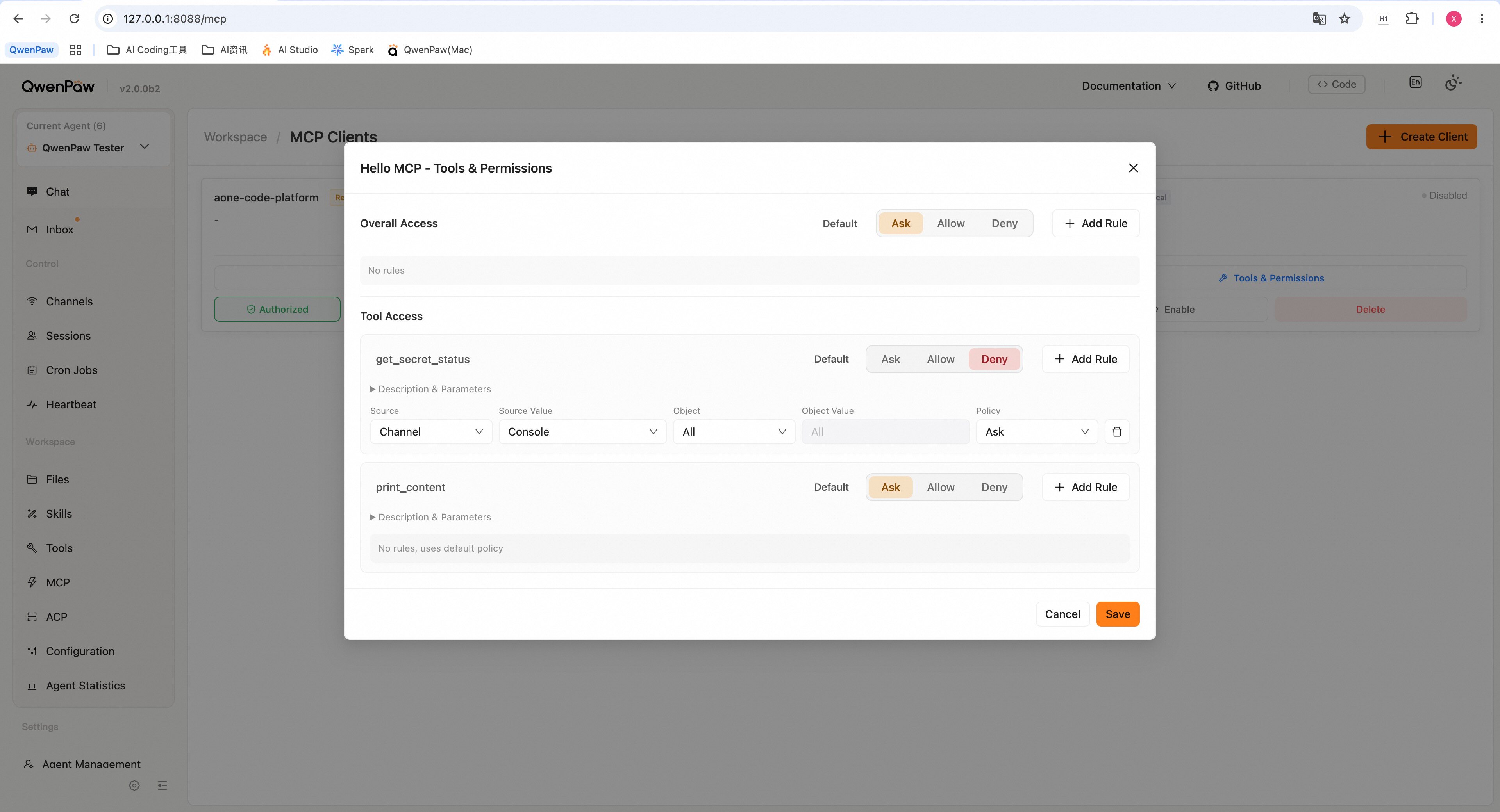
In the Console under **Agent → MCP**, click **Tools & Access** on any MCP client card to visually manage access policies:
|
||
|
||
|
||
|
||
- Set client-level default effect (Ask / Allow / Deny)
|
||
- Add override rules for specific source channels and users
|
||
- Set independent access policies for individual tools
|
||
- Changes take effect immediately upon save — no restart required
|
||
|
||
## End-to-End Invocation Flow
|
||
|
||
A complete Driver invocation traverses the following stages:
|
||
|
||
```
|
||
User request → list_capabilities() → build_agent(toolkit)
|
||
→ LLM decides to call a tool
|
||
→ DriverCapabilityTool.__call__()
|
||
→ DriverManager.invoke_capability()
|
||
→ parse capability_id → route to correct Handler
|
||
→ Handler._authorize_invocation() [policy adjudication]
|
||
→ Handler.protocol_execute() [protocol execution]
|
||
→ DriverInvocationResult → Agent continues reasoning
|
||
```
|
||
|
||
Driver connections are persistent at the Workspace level (MCP client sessions stay alive in-process), while Agents and Toolkits are rebuilt per-request. This ensures the right balance between **resource reuse** and **isolation safety**.
|
||
|
||
## Looking Ahead
|
||
|
||
The Driver module establishes a unified external capability access foundation for the QwenPaw Agent system. MCP protocol support is now shipped; A2A and ACP Handler skeletons are ready. Future directions include:
|
||
|
||
- **More protocols** — Full A2A (Agent-to-Agent) and ACP protocol implementations
|
||
- **Observability** — Invocation chain tracing and policy adjudication audit logs
|
||
|
||
Driver's design philosophy: **Let Agents focus on reasoning; let Drivers handle the complexity of connection.** No matter how external protocols evolve, Agents always see a unified Capability model.
|